
Türkçe Yeni Yaşam Gazetesi | Français | English | Castellano
Eren Keskin is a lawyer, an indomitable defendor of human rights, one of the most precious activists and symbolic personalities in Turkey. She is also the Co-President of IHD, the Human Rights Association.
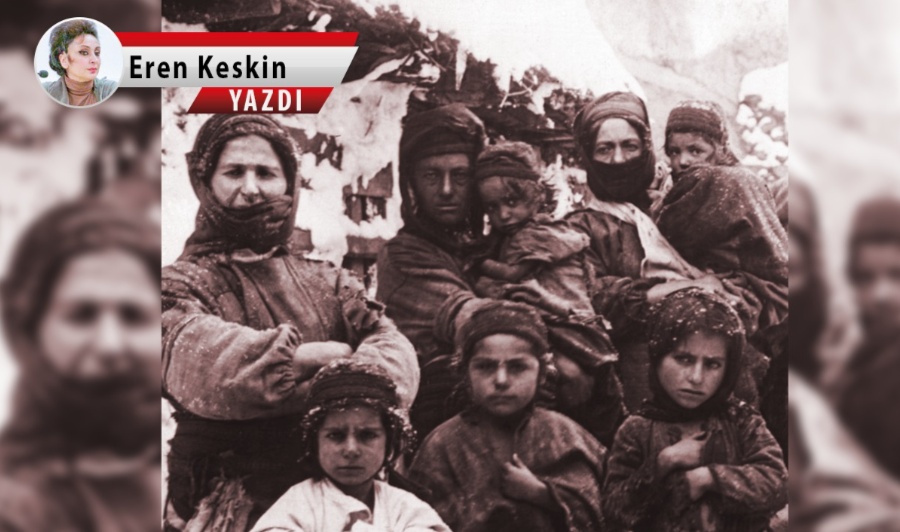
The following is a free translation of her article concerning the Armenian genocide, published in Turkish on April 28 2021 by Yeni Yaşam Gazetesi.
1915 and my aunt’s story
At the IHD we commemorate the Armenian genocide of 1915 since 2005 and, to this day, we have organized a number of initiatives, none of which have received as many echoes as those organized in the past two years. In 2019, the street initiative we had organized was blocked. At the demonstration, our placards were confiscated and three comrades were taken into custody. Following the judicial process, the prosecutor decided there could exist differing opinions one could express relative to historical events, and that this remained within the scope of freedom of thought. The accusation was thus dismissed.
But in this year 2021, especially following the use of the word “genocide” by President Biden of the United States, it was a circus. The IHD, despite the fact it has organized commemorations since 2005, was targeted by the Minister of the Interior.
My awareness of the Armenian genocide did not come through political means, but through a family event I experienced.
My paternal grandfather was a lawyer, he was also a deputy prefect and well-known as a democrat in his surroundings. My uncle, my father’s twin brother, was a widower and decided to remarry. When he mentioned his wish to my grandfather, the latter imposed one condition. My future aunt, who went by the name of Joséphine, had to adopt the name of Hülya and become a Muslim. She accepted.
My aunt Josephine and her family are the most joyous people I have known in my life. We went to the cinema together. Josephine’s nephews, brothers Alex and Arthur, taught us the tricks of Zati Sungur, the famous illusionist.
At the time of the marriage, I asked my mother “must we now call aunt Josephine aunt Hülya?” Insisting on the fact that my grandfather had behaved in a scandalous way, my mother answered “always call her aunt Josephine.” This answer has also influenced my struggle.
When I was 16–17 years old, I started learning certain things about the Armenian genocide. One day, I asked my aunt: “Auntie, was your family affected?” In telling me that her family was indeed affected but that I must not mention this topic, she answered “Never talk about this anywhere. It’s a dangerous topic.” On that day I started seeing clearly about the Armenian genocide. I thought it was sad that a human being was afraid to speak about her own suffering.
My uncle died young and Josephine raised his two sons from his first marriage as if they were her own, then she adopted them officially and made them her heirs.
My aunt fell sick. She was on her death bed. I visited her. In her room, I saw she was speaking with a priest her nephew had called in from the church. My aunt was crying, and so was the priest… She wanted to tell about certain things, but could not bring herself to speak. In my eyes, my aunt was performing her own funeral rite that day, according to her own rules. Perhaps was she telling the priest in this way “I never gave up.”
I was deeply moved by this image. Perhaps this dialogue between two people was an important conversation that would explain realities we are discussing today.
My aunt died soon after. She was buried as a Muslim. But I am certain she would have wanted it to be done the way she discussed with the priest that day. Truly, on that day, my aunt was lifting up her head and perhaps telling the priest that she refused an identity that was imposed on her.
I did not go to my aunt’s funeral. On that day, I went to the church. And I gathered my thoughts for my aunt, in a way I think she would have wanted. And I go on commemorating her in this way.
Now, I ask. My aunt was not the only one. She was an Armenian who was forced to conform to the dominant ones. Should we consider what my aunt experienced as a great suffering that was imposed on her in an isolated fashion, or was it the continuation of a genocide?
Translation by Renée Lucie Bourges
You may use and share Kedistan’s articles and translations, specifying the source and adding a link in order to respect the writer(s) and translator(s) work. Thank you.